
What is Professionalism? 10 Qualities Every Network Marketing Professional Should Have
What is professionalism in network marketing?
Professionalism is actually an essential trait both in business and society. It is that quality that drives a person’s appearance and personal and professional interaction and that provides others with a first impression.
Most people can actively recognize professionalism or the lack of it in others but find it extremely difficult to define it when considering their own behavior. The word “professionalism” is associated with being professional in terms of exhibiting an outcome that a particular profession demands.
A person can be associated with any profession, but he would not be termed a professional till the time he demonstrates the standard of the highest degree that a particular profession requires. Knowledge, exhibition, demonstration of professional capabilities, and the experience that people gain from such professional gets reflected in the form of professionalism.
You remove the word “professionalism,” and what you have is an experience that in no way reflects the intricacies associated with a profession. Every profession has its standard, and the people who comply with such standards are called professionals. It is the display of professional capabilities that constitutes professionalism and gives true meaning to a particular profession.
There would be different meanings for this particular word, “PROFESSION,” but it is true in its own sense; what they miss is experience. The experience that one gets when one deals with a professional, vis-à-vis normal people. It is in experience that lies the true essence of professionalism.
“The reason you respect people of a certain profession is only that they demonstrate professionalism. Remove professionalism, and all you are left with is nothing but a normal experience that you can get from anywhere.”
Qualities Every Network Marketing Professional Should Have.
- A good role model for others, including their behavior, attitude, and relationships.
- Good timekeepers—always in before time and use time well.
- Dresses appropriately for the role.
- Speak in an appropriate way to difference audience without being patronizing or putting people down.
- Knowledgeable about the job, organization, etc.
- Good with people.
- Communicates effectively, whatever the circumstance—actively listens.
- Manage their time well.
- Work well under pressure.
- Fulfils deadlines.
- Prioritizes effectively—is prepared to put in the time and effort to get things done, but also manages to have a reasonable work-life balance.
- Is accountable and takes responsibility for what they do and say and for what they leave undone.
- Is able to run an effective meeting—They are well versed in when to speak and when not to speak in a meeting.
- They are open to the views and suggestions of others and make decisions in the best interest of the organization.
- Professionals see themselves as part of the solution rather than the problem.
If you are keen to succeed in any business, you need to demonstrate that you have the potential to fulfill the role. Just wanting the job, the title, status, and financial reward is simply not enough. You will also gain a huge amount of personal satisfaction in knowing you have what it takes to be a great professional.
IMPORTANCE OF PROFESSIONALISM IN NETWORK MARKETING
Why is professionalism important in network marketing?
- Professionalism in the workplace is important to ensure good performance by all. If everyone is professional, everyone will do the best they can at their job.
- Professionalism in the workplace is required to ensure a good team spirit. If people work professionally, they will know how to value their organizational goals along with their personal ones.
- Professionalism is required to keep all the employees motivated. Happy employees are positive brand ambassadors for the organization. Keeping the employees motivated is important to keep a good reputation in the office.
- It is important to ensure justice for everyone’s efforts. In a professional environment, a person’s quality of work is taken into consideration along with the quality of their work. This phenomenon does justice and appreciates the efforts of the employees.
- Professionalism in the workplace helps maintain the right amount of communication at the workplace. It also ensures that whose required to be heard are heard.
Professionalism is the axis around which any organization revolves. Without the axis, the organization will be lost in the galaxy of politics, mind games, and blame games.
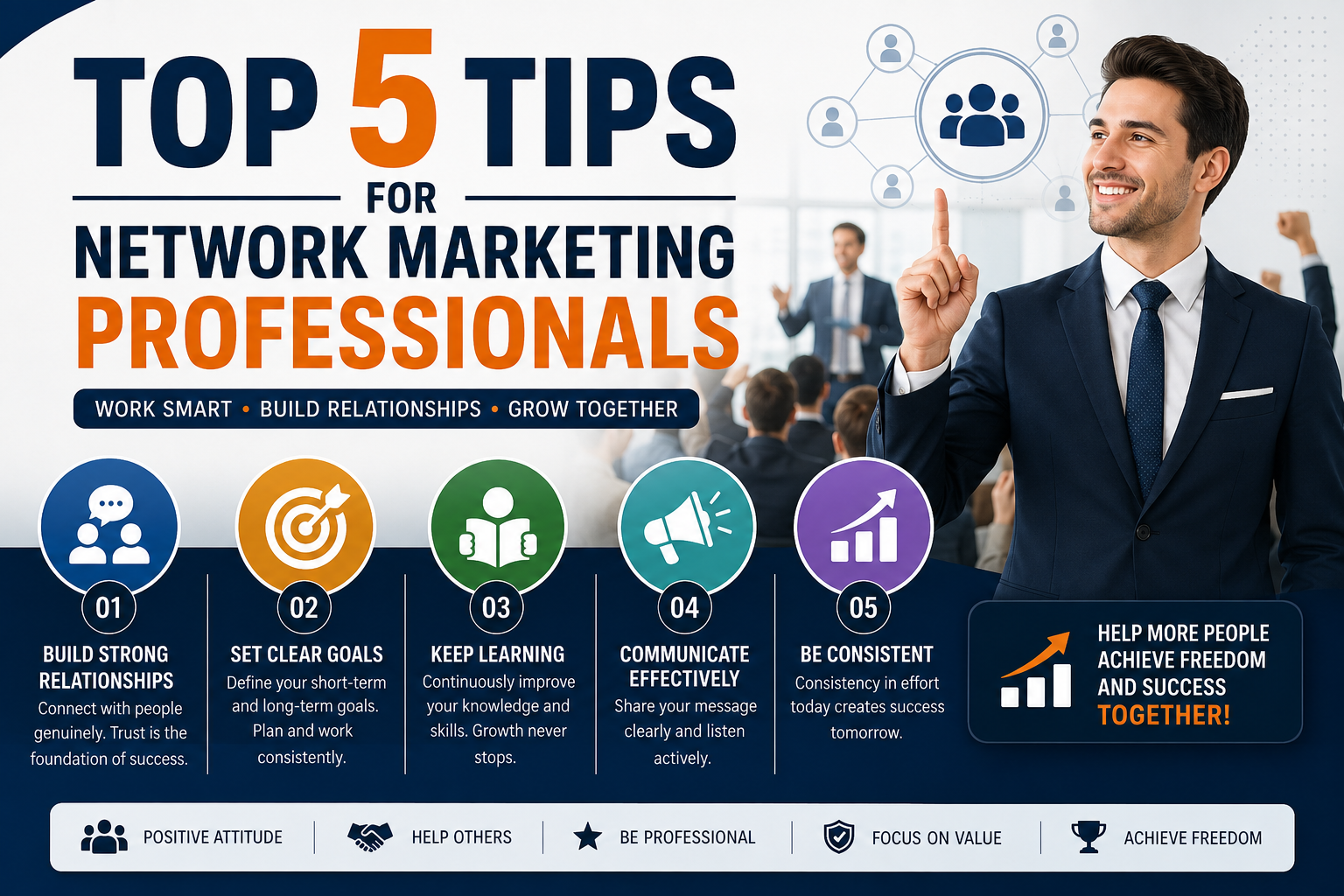
TOP 5 TIPS FOR NETWORK MARKETING PROFESSIONALS
So, now that we know what professionalism in the workplace is all about, it is important to know how to induce it in the employees. The employees who make an organization—it is very important to ensure that professionalism is understood by the employees who make up an organization. So, how do you conduct “professionalism training in the workplace”?
- Keep a uniform environment for communication. If you wish to refer to each other with formalities (that is, with the surname or using “sir” and “ma’am”), then let that be constant for all in the workplace. If you want a more friendly environment, then let everyone use their first name. Whatever you choose, it has to be constant and uniform for all.
- It is important that you make sure that all employees are aware of the professional environment at work. While their personal issue will be considered by the management when required, they need to abstain from discussing it during office hours. This keeps the office environment free from empathy-related biases about productivity.
- Employees should be told to abstain from the concept of competition-bashing. Often in the heat of the moment, employees go about bashing their competition’s reputation. This would include complaining to the management about certain aspects of them or spreading rumors via the grapevine. This should be avoided at all times. If anyone is found indulging in such activities, strict action should be taken at the earliest.
- Punctuality is very important. If the office has fixed working hours, they should be abided by by all the employees. In case there is a deviation by any employees, they should either inform beforehand, cover up the work in the near future, or complete their day’s target within the span of time.
- Professional dress code should be maintained. Luring seniors by wearing provocative clothes is a very well-tried and tested method. If one wishes to avoid the use of such tactics at the workplace and avoid the possibility of fraternizing within the workplace, it is important to make sure that everyone dresses in a certain manner that is acceptable to all in the management.
These training tips show how to keep the environment professional, yet flexible. A professional environment does not necessarily have to be restrictive.
LACK OF PROFESSIONALISM IN THE WORKPLACE
Professionalism in the workplace is responsible for several positive actions in the organization. AS a flip side to the coin, lack of professionalism will be responsible for several negatives.
- Lack of motivation at work often occurs due to a lack of professionalism.
- Lack of professionalism will lead to employees not thinking of the organization as their own, but as a place where they are till something better comes up. It will lead to declining job satisfaction.
- Lack of professionalism leads to unethical acts in the company that would mar its reputation.
- Lack of professionalism leads to a higher attrition rate, which keeps the organization’s recruitment budget in use at all times, causing it a financial strain.
- It also leads to a lack of loyalty between the management and the employees, making the basic functioning in the organization difficult.
HOW TO BECOME A PROFESSIONAL? HOW DO I BECOME PROFESSIONAL
With a certificate, diploma, or college degree under your belt, you have opened the door to many career opportunities in your future. In addition to this, there is more to know when it comes to how to become a professional.
Here are some tips on developing a professional manner:
- Be well-groomed, clean, and pressed, head to toe, every day.
- If you have a moment’s doubt about whether something is appropriate to wear in the workplace, don’t wear it.
- Avoid clothes that are too tight or revealing.
- Use restraint with cologne and perfume.
- Hide tattoos.
A GOOD CHARACTER
- Be honest
- Be reliable
- Be positive
- Be true to yourself
- See your job as an extension of who you are.
EFFECTIVE COMMUNICATION IS ESSENTIAL FOR PROFESSIONAL SUCCESS
Effective communication in the workplace is the driving force of any successful business.
- Speak clearly and in a light, friendly manner.
- Pay attention to others and what goes on around you.
- Communicate honestly and directly but always with tact and respect.
- Express your beliefs even if you don’t agree, but remain positive and supportive of the organization.
- Communicate with care via telephone and email, since that is often the first contact others make with you and your company.
- See the big picture and make connections between people and events.
REPRESENT THE ORGANIZATION
You, as an employee, are the representative of your organization at all times, and your behavior reflects that organization.
- Demonstrate a vested interest and commitment to our organization.
- Clearly and accurately articulate your company’s mission.
- Take pride in your work.
PROFESSIONALISM REQUIRES EMOTIONAL INTELLIGENCE
One of the greatest challenges of any workplace is developing work relationships with co-workers, customers, or clients. To become a professional, you must handle your emotions with grace and intelligence.
- It is natural to feel angry with others, even on the job; however, it is never appropriate to act out on anger.
- Take responsibility for your actions.
- Develop solid working relationships by showing kindness and respect to all.
- There can be incidents on the job or co-workers that may cause you happiness or harm. Figure out how to promptly and calmly discuss this with the appropriate party, avoiding drama and tattling.
- Avoid gossip.
IMPORTANCE OF PROFESSIONAL ETTIQUETTE
As a working professional, it is expected from you to understand the culture of your workplace, and thus, it becomes essential to follow some basic professional etiquette. The basis of professional etiquette stands on the ethics of respecting other individuals in your workplace and displaying courteous behavior during business interactions.
Professional etiquette can have a long-lasting and far-reaching impact on professional life; be it your personal career growth or a rising business for your company. Your professional etiquette can thus put you in the good/bad book of your immediate boss or potential clients.
Get Digital Marketing Services From Flizon Technologies.
BASIC PROFESSIONAL ETIQUETTE TIPS FOR NETWORK MARKETER
Mentioned below are some basic professional etiquette tips that you can follow to make a great impact on everyone in your company.
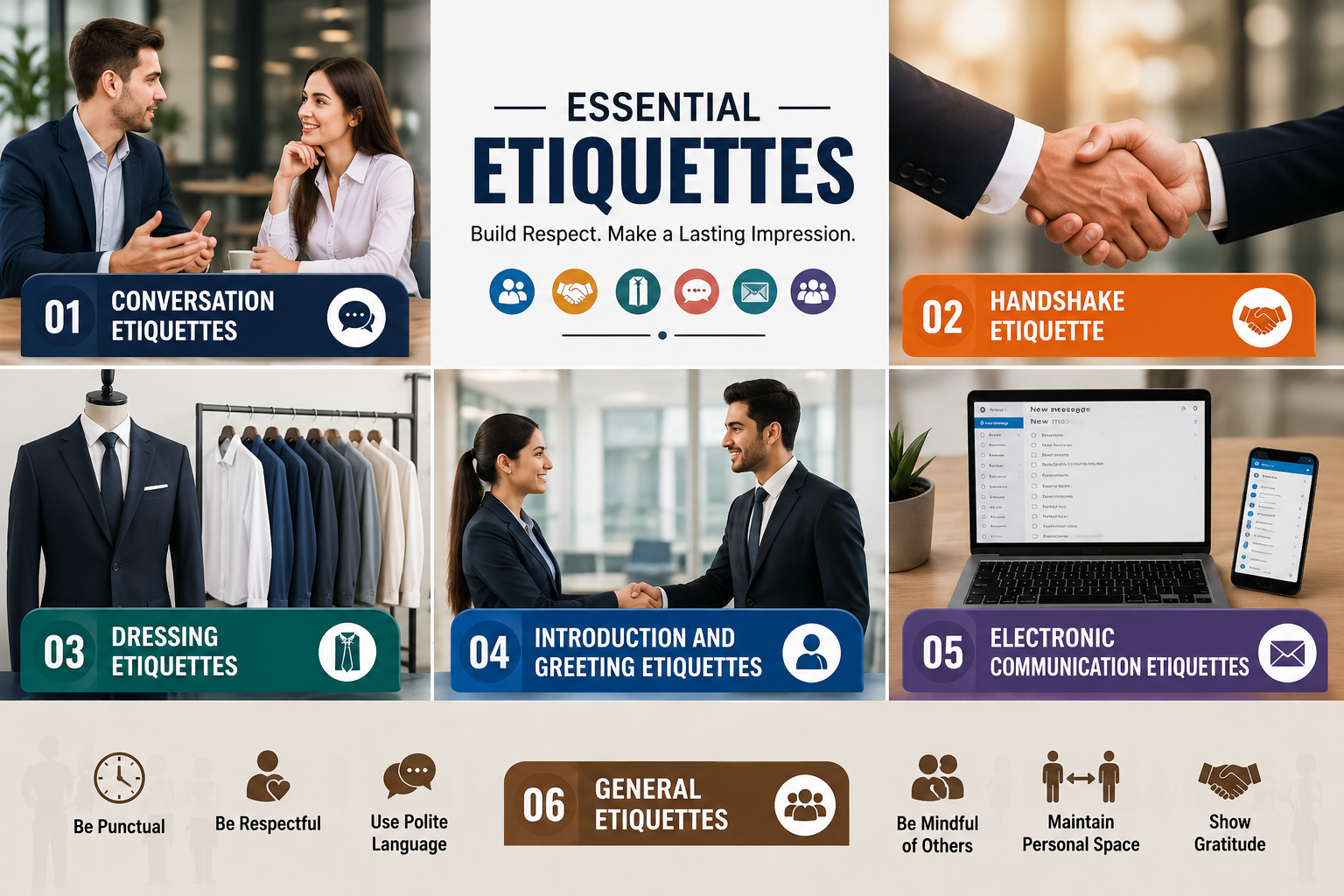
CONVERSATION ETIQUETTES

- Always listen to others attentively. A good listener is always too dear to every client. Speak only when the other person has finished talking instead of interrupting in between.
- Keep a low but clear and calm voice while conversing. Your tone should always be polite.
- While conversing, always look into the eyes of the other person and avoid showing your back or looking elsewhere.
- Keep your conversation short and to the point instead of getting into irrelevant topics and discussions. Remember, this is a business talk and not a family reunion.
- Maintain your sobriety and politeness even if the client says something offensive or rude, and avoid replying back in harsh/toneless words.
- Avoid fidgeting with your dress or putting your hands on your face while in a conversation.
HANDSHAKE ETIQUETTE
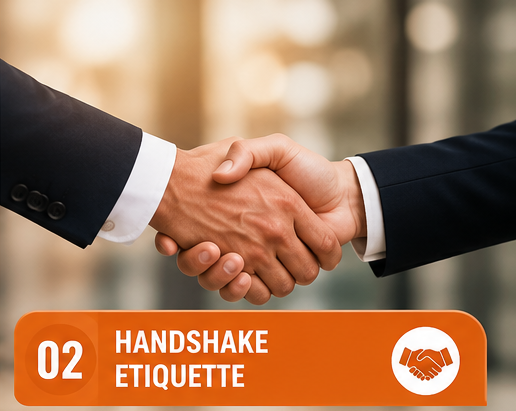
- When shaking hands, always offer a firm handshake with your finger tilted down and your thumb up. However, ensure your handshake is not so firm that it crushes or hurts the other person’s hand. This indicates that you are dominant.
- Limit the time of the handshake to 2 to 3 seconds and take your hand back gracefully.
- Avoid patting on the back of the hand.
- While shaking hands, greet the person by looking into his/her eyes.
DRESSING ETIQUETTES
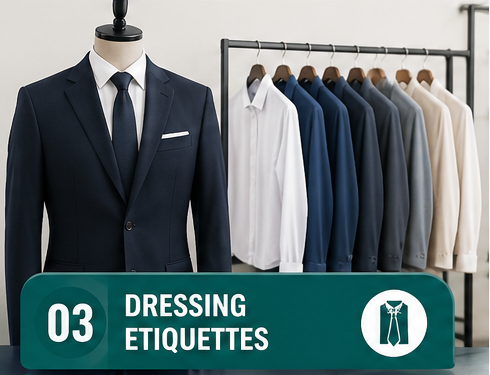
- Always wear neat and nicely pressed formal clothes. Choose corporate shades while you are picking up clothes for your office wear.
- Women should avoid wearing exposing dresses and opt for little but natural make- ups. Men need to keep their hair (including facial hair) neatly trimmed and set.
- Always polish your shoes.
- Keep your nails clean.
- Wear clothes that you are comfortable in and carry well. This is very important when you are in a business meeting or client presentation.
INTRODUCTION AND GREETING ETIQUETTES
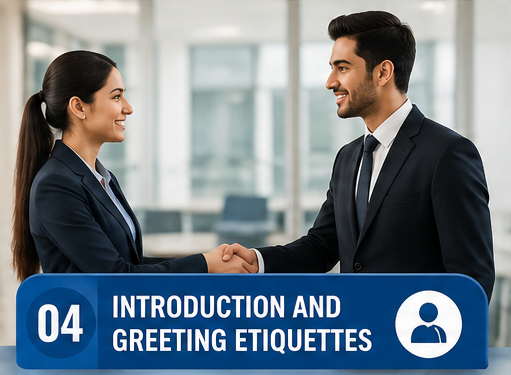
- When you are getting introduced, either shake hands or nod your head.
- If you are in charge of introducing other people, always introduce the lower-ranked person to the higher-ranked one.
- When first introduced, stand up to meet or greet the person.
ELECTRONIC COMMUNICATION ETIQUETTES
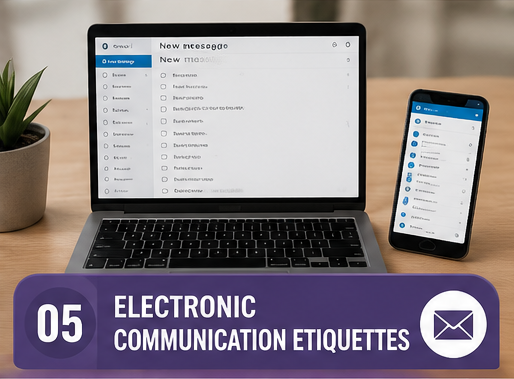
- While communicating with your colleagues, seniors, or clients through email, always address the person with “DEAR,” “HI,” or “HELLO” followed by a title (Mrs./Mr./Miss, etc.) and his/her name, and end your mail with “YOURS SINCERELY” or “YOURS TRULY,” whatever suits best your name and designation. Also, always mention the “subject” for all your official emails.
- Keep official emails preferably short and precise. However, if the subject demands elaborate detail and explanations, go ahead, but use friendly, formal language instead of casual ones.
- While speaking over the telephone, always greet the other person when starting and ending the call. Always speak politely.
- Include your contact details and the date while sending faxes.
- While participating in conference calls, introduce all the participants to each other at the beginning.
Network marketing business के लिए invite कैसे करें? Safe Shop Invitation Technique
GENERAL ETIQUETTES
- Always be punctual at your workplace.
- Switch off or put your mobile in silent mode during a conference call, business meeting, or corporate presentation. In case it is an urgent call that you need to take, excuse yourself and take permission from the others for taking the call.
- Avoid picking your nose in public.
- Use a handkerchief when you are coughing/sneezing in public.
- When in a meeting room, always stand up to greet the seniors if they arrive after you.
- Try to ignore and overlook funny or embarrassing sounds when in a meeting or official conversation.
- If you have forgotten somebody’s name, ask his/her politely, saying that you are sorry that you can’t remember the name.
- Always keep a comfortable distance while conversing with others. Avoid standing or sitting too close to the other person. An arm’s length would be ideal to maintain the comfort zone.
- Be careful while smoking and drinking when you have company. Find out if the person is comfortable with your smoking. Avoid excessive drinking when in a client meeting.
- It would be nice if you held the door for the person who is coming immediately behind you.